Anyone who's hauled a lead-acid battery in and out of an RV, boat, or golf cart knows the frustration: they're heavy, they degrade fast, and they demand constant maintenance just to keep working. DC House has built its entire brand around fixing that problem with LiFePO4 (Lithium Iron Phosphate) batteries positioned as a genuine middle ground offering features usually reserved for premium lithium brands, at a price that undercuts them significantly.
We looked at the technology behind the claims, the real cycle-life numbers, and honest owner feedback to see whether DC House actually delivers.
Quick Verdict
DC House has carved out a real niche as a budget-friendly LiFePO4 option that doesn't feel budget in the ways that matter most genuine cycle life, real safety certifications, and smart features like Bluetooth monitoring that used to be exclusive to premium brands.
It's not flawless: some owners report inconsistent app readings, and getting the full advertised lifespan requires following lithium-specific charging and storage practices that lead-acid users may not be used to. For RV, marine, golf cart, and off-grid solar use, it's a genuinely strong value pick just go in understanding it's a deep-cycle battery, not a starter battery.
What Makes LiFePO4 Different From Lead-Acid
DC House batteries use Lithium Iron Phosphate chemistry, which matters for two reasons: safety and longevity. Unlike Lithium Cobalt Oxide (the chemistry in most phone batteries), LiFePO4 is thermally stable and highly resistant to ignition from overcharging or physical damage a meaningful safety advantage for a battery living in an RV or boat.
The bigger practical difference is cycle life. A typical lead-acid battery is good for roughly 400 charge cycles before meaningful degradation. DC House rates its standard lineup for 4,000-plus cycles at full depth of discharge, and up to 15,000 cycles if you limit discharge to 50-60% each cycle. That's not a marginal improvement it's an order of magnitude difference, and it's the core reason LiFePO4 has been steadily taking over the leisure battery market.
Lithium cells are also far less sensitive to being left partially discharged for extended periods, a common failure point for lead-acid batteries that shortens their usable life even with careful use.
The DC House Lineup
100Ah The Flagship
This is DC House's best-known model and, according to independent testing, currently the top-selling 100Ah LiFePO4 battery in the UK. It uses newer-generation LiFePO4 cells — notably fresher than some competitors still shipping cell technology that's five or six years old — and serves as the baseline against which the rest of the lineup is measured.
200Ah Built for RV and Off-Grid Power
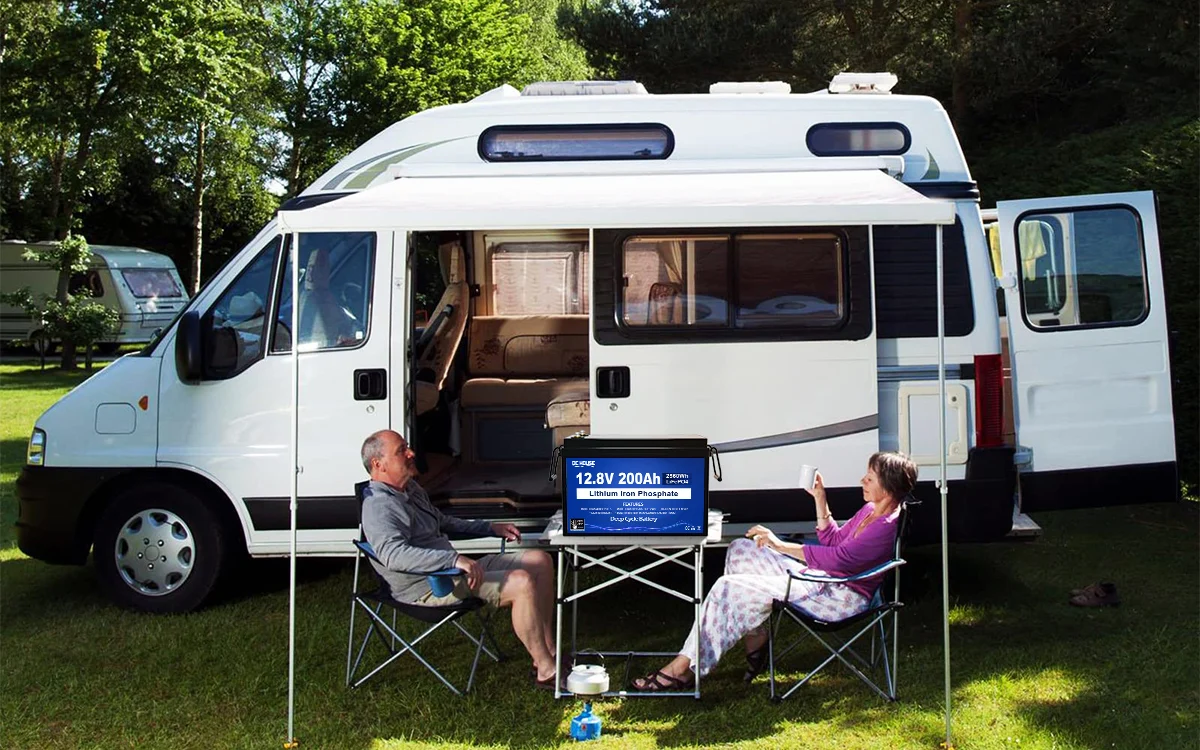
The larger-capacity option, aimed at RV owners and off-grid solar setups that need more sustained power between charges — exactly the kind of setup shown in DC House's own marketing, powering a laptop and small appliances at a campsite. Same cell quality and safety features as the 100Ah model, just scaled up for higher-draw or longer-duration use.
48V Systems Golf Cart Conversions
DC House also makes higher-voltage packs specifically designed as drop-in replacements for traditional 48V golf cart battery banks — swapping out six individual 8V lead-acid batteries for a single sealed lithium unit. Real-world testing on cart conversions has reported faster acceleration, shorter braking distances, and better performance on inclines compared to the lead-acid setup being replaced, along with eliminating the watering and terminal maintenance lead-acid demands.
Real Owner Feedback: Pros and Cons
What owners consistently praise:
- Genuine build quality on the casing, terminals, and power switch, even from owners who haven't opened the unit to inspect internal components
- Significantly lighter than the lead-acid batteries being replaced, making installation and handling much easier
- Bluetooth app monitoring for real-time state of charge, cell voltage balance, and temperature a feature that used to be limited to premium brands
- Strong safety credentials, including UL/UN38.3 certification
- Positive experiences reported specifically from users doing mid-grade lithium conversion projects, citing consistent results across multiple installs
Where it consistently falls short:
- Occasional inconsistencies in the app's state-of-charge readings have been flagged as a practical trade-off compared to premium-tier brands with more refined monitoring software
- Chargers sometimes ship separately from the battery, which at least one owner reported added around a week to receiving a fully usable setup
- Getting full advertised lifespan requires lithium-specific care — this isn't unique to DC House, but it's a real adjustment for anyone used to the more forgiving (if shorter-lived) nature of lead-acid
Important: What These Batteries Are Not For
This is worth stating clearly, since it trips up some first-time lithium buyers: DC House's LiFePO4 batteries are deep-cycle batteries designed for steady, sustained discharge — powering appliances, lighting, and electronics over time. They do not have the Cold Cranking Amps (CCA) rating required to start a combustion engine, so they're not a replacement for a vehicle starter battery.
If you need to both start an engine and run house loads, you'll typically want a separate starter battery alongside a lithium deep-cycle bank like this one.
How to Get the Most Life Out of One
A few practices genuinely affect how close you get to the advertised cycle life:
- Use a lithium-specific charger: An old lead-acid charger won't deliver the correct constant current/constant voltage (CC/CV) charging profile lithium cells need, and can shorten battery life over time.
- Size your cables correctly: For higher discharge rates (around 100A), at least 4 AWG copper wire is recommended to avoid voltage drop and excess heat.
- Store at 50-60% charge: Not full or empty, and disconnect the terminals if the battery will sit unused for an extended period, such as winter storage.
- Check your solar controller settings: MPPT or PWM controllers need a "Lithium" or "LiFePO4" profile selected rather than a generic or lead-acid setting.
- Avoid over-chaining: Don't exceed four batteries in series or parallel without confirming compatibility, as DC House specifically flags this as a risk area.
DC House vs. Premium Lithium Brands
Independent reviews consistently place DC House in a "sweet spot" position — offering features like Bluetooth monitoring and low-temperature protection that are typically associated with higher-end brands, but at pricing that sits closer to entry-level lithium options.
It's not positioned to outperform top-tier premium brands on refinement (particularly app polish), but for the price gap, reviewers generally consider it a legitimately balanced trade-off rather than a compromise that shows up in core battery performance.
Who Should Buy DC House
Good fit if you:
- Are upgrading an RV, boat, or golf cart from lead-acid and want dramatically better cycle life and lighter weight
- Want smart monitoring features (Bluetooth app, real-time SOC) without paying premium-brand pricing
- Are comfortable following lithium-specific charging and storage practices rather than treating it like a lead-acid battery
- Need a deep-cycle house battery, not a vehicle starter battery
Consider alternatives if you:
- You need CCA for engine starting this isn't the right battery type regardless of brand
- App refinement and zero reading inconsistencies are a dealbreaker for you premium brands may offer more polished software
- You want the charger included and shipped together with the battery every time confirm current bundling before ordering
Frequently Asked Questions
Can a DC House lithium battery start my car or boat engine?
No. These are deep-cycle batteries designed for sustained power draw, not starter batteries they don't have the Cold Cranking Amps rating needed to start a combustion engine.
How long do DC House batteries actually last?
DC House rates its standard lineup for 4,000-plus cycles at full depth of discharge, with up to 15,000 cycles achievable if you limit each discharge to 50-60% rather than fully depleting the battery each time.
Do I need a special charger for a DC House lithium battery?
Yes. Lithium batteries require a charger with a constant current/constant voltage (CC/CV) profile specifically designed for lithium chemistry using an old lead-acid charger can reduce battery lifespan.
Is DC House a good replacement for lead-acid golf cart batteries?
Real-world conversion testing has reported meaningfully better performance (faster acceleration, shorter braking, better incline handling) after switching from a traditional six-battery 8V lead-acid bank to a single DC House 48V lithium pack, along with eliminating regular watering and terminal maintenance.
The Bottom Line
DC House has positioned itself well in the crowded LiFePO4 battery market genuine cycle-life performance, real safety certifications, and smart monitoring features at a price that undercuts premium competitors without cutting corners on the core battery technology. The trade-offs are minor rather than fundamental: some app inconsistencies and a charging/storage learning curve that comes with lithium chemistry generally, not this brand specifically. For RV, marine, golf cart, or off-grid solar use, it's a genuinely strong value option worth serious consideration.