About 86% of American workers now hold jobs that require sitting for most of the day, and the consequences are adding up quietly in the background. According to workplace health data, 65% of desk workers develop back pain specifically from the unconscious postural adaptations their body makes while sitting not from any single injury, but from small, repeated compromises made hour after hour, day after day. Nationally, back pain now costs employers an estimated $12 billion a year in lost productivity, absenteeism, and workers' compensation.
Here's what's actually going wrong at most desks, what good posture looks like by comparison, and why the chair you sit in matters far more than any amount of "sit up straight" willpower.
What Bad Desk Posture Actually Looks Like
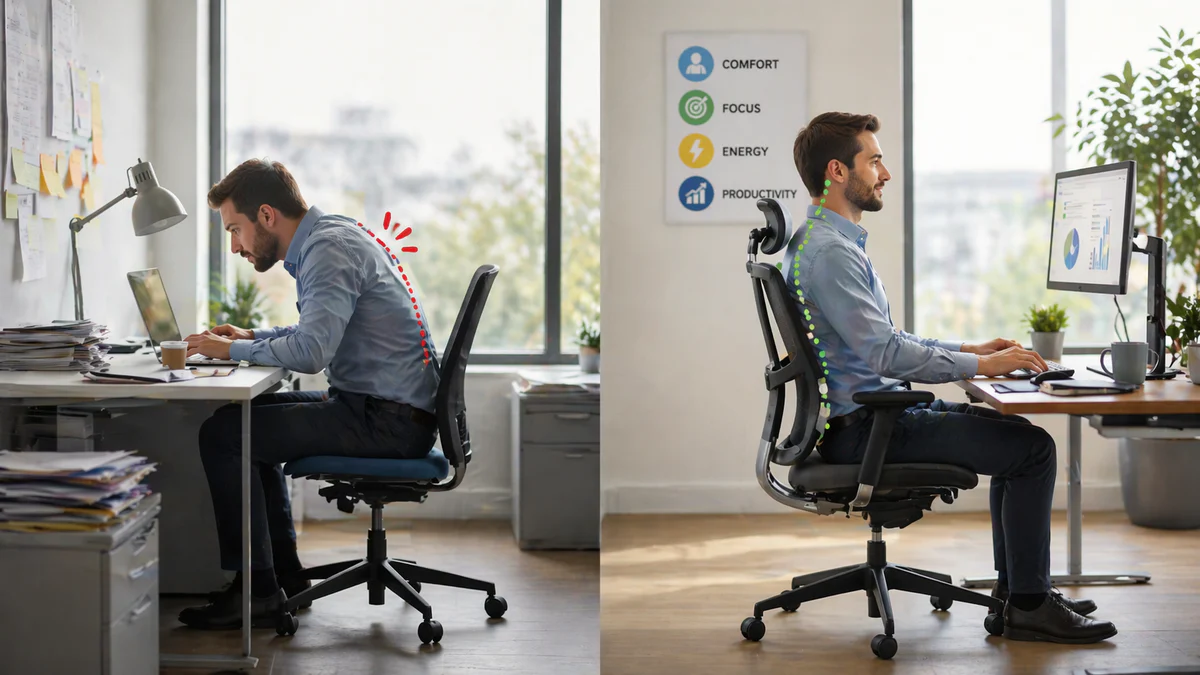
Slouched, forward-leaning posture at a desk is one of the most consistently identified risk factors for chronic back pain among office workers, and it usually builds gradually rather than happening all at once. The common pattern looks like this:
- Rounded upper back and shoulders, curving forward toward the screen or keyboard
- Forward head posture ("tech neck") — the head drifts ahead of the shoulders, placing sustained strain on the neck and upper spine
- No lower back support, allowing the lumbar curve to collapse and flatten over hours of sitting
- Hunching closer to the screen as fatigue sets in through the day, worsening spinal curvature further
- Legs and hips in fixed, static positions, reducing circulation and adding to stiffness by the afternoon
None of this happens because someone is careless. It happens because most chairs don't actively support a neutral spine so the body slowly collapses into whatever position requires the least muscular effort to hold, which is rarely the position that's actually good for you.
What Good Desk Posture Actually Looks Like
By contrast, proper sitting posture keeps the body in a neutral, supported alignment rather than requiring constant conscious correction:
- Ears, shoulders, and hips stacked in a straight vertical line not leaning forward or slumping back
- The lower back's natural inward curve maintained, rather than flattened or rounded
- Shoulders relaxed and level, not hunched up toward the ears or rounded forward
- Feet flat on the floor, with knees roughly level with or slightly below the hips
- Monitor at eye level, about an arm's length away, so the neck doesn't need to bend forward or look down

The key difference between these two postures isn't effort or discipline it's support. Good posture is what your body settles into naturally when the chair underneath it is actually built to hold that alignment.
Why Your Chair Is the Real Root Cause
This is the part most posture advice gets wrong. Reminders to "sit up straight" or posture-correcting braces address the symptom, not the cause. If the chair itself doesn't provide adjustable lumbar support, a properly sized seat, and a backrest that moves with your body, you'll drift back into poor posture within minutes no matter how much willpower you start with.
Physical therapists specializing in occupational health consistently point to the same fix: a chair with genuine adjustability, specifically lumbar support that maintains the lower back's natural curve, combined with correct monitor height to prevent forward head posture. Common ergonomic pitfalls monitors set too low, chairs that don't adjust to the right height, non-adjustable armrests forcing shoulders into an unnatural position compound over a full workday into exactly the kind of chronic strain the research describes.
The Ergonomic Chair Built to Fix This: Sihoo
This is exactly the gap Sihoo has built its entire lineup around genuinely adjustable ergonomic chairs at a price point well below premium competitors, engineered around the specific posture problems described above rather than just general comfort.
Sihoo M18 Best Entry Point
The M18 directly targets the two biggest posture failure points: lumbar collapse and neck strain. Its adjustable lumbar support keeps the lower back's natural curve intact through long sitting sessions, while the height- and rotation-adjustable headrest helps counter forward head posture rather than letting it develop unchecked. The wide, W-shaped foam seat also keeps hips properly supported rather than encouraging the kind of slouched, sliding-forward sitting that gradually rounds the spine. At $140-$200, it's widely regarded as one of the best value entry points into genuine ergonomic support.
Sihoo M57 Best for All-Day Adjustability
The M57 builds on the M18 with a wider range of armrest adjustment — directly relevant to posture, since armrests set at the wrong height are a common cause of hunched, rounded shoulders. Getting arm support at the correct level takes pressure off the neck and upper back that would otherwise creep into poor posture by mid-afternoon.
Sihoo Doro C300 Pro Best for Existing Back Pain
For anyone already dealing with back discomfort from months or years of poor desk posture, the Doro C300 Pro's dynamic lumbar support (which moves with your posture rather than staying fixed) and 4D adjustable armrests offer the most complete correction in the lineup. Reviewers specifically highlight its "cradling comfort" as genuinely effective for back pain relief — though it's worth noting the $699 listed price regularly drops to around $399, so it's worth waiting for a sale rather than paying full retail.
Frequently Asked Questions
Can a better chair really fix bad posture on its own?
A genuinely adjustable ergonomic chair removes the biggest structural causes of poor posture collapsed lumbar support, wrong seat height, poorly positioned armrests but pairing it with correct monitor height and regular movement breaks gives the most complete result.
How quickly can switching chairs improve posture-related pain?
This varies by individual and how long the underlying strain has built up, but addressing the root cause (proper lumbar and postural support) is consistently identified as more effective than temporary fixes like posture correctors alone.
Which Sihoo model is best if I already have back pain?
The Doro C300 Pro, with its dynamic lumbar support and more extensive armrest adjustability, is the model most specifically highlighted for back pain relief in independent reviews.
The Bottom Line
Bad desk posture isn't a willpower problem it's usually a support problem. The body settles into whatever position a chair allows, and if that chair doesn't actively maintain a neutral spine, hunching and strain build up gradually over months of otherwise ordinary workdays. A genuinely adjustable ergonomic chair, like Sihoo's M18, M57, or Doro C300 Pro depending on your budget and needs, addresses the actual mechanical cause rather than asking you to consciously fight your posture all day long.